Level 3 NVQ (2357)
Who are the qualifications for?
The level 3 (NVQ) meet the needs of learners in England, Wales and Northern Ireland who want to work as an electrician, installing systems and equipment, in buildings, structures and the environment within the electrotechnical industry.
What do the qualifications cover?
They allow candidates to learn, develop and practise the skills required for employment and/or career progression in the electrotechnical sector.
What will learners be able to do?
The qualifications contribute knowledge, understanding, and practical skills regarding Installing Electrotechnical Systems and Equipment. Once candidates have learnt the required skills and knowledge, they will demonstrate their occupational competence in the workplace within these qualifications.
Level 3 Award in Periodic Inspection & Testing (Combined 2391-52), coming soon.
Book your place now ! Book your place now !! Book your place now !!!
Date: 27/02/26 – 01/03/26, Time: 10:00am – 16:00pm
The 2391 (City & Guilds) Inspection and Testing qualification (specifically 2391-52) is a key UK qualification for experienced electricians, combining initial verification (new installs) and periodic inspection (existing systems) into one award, covering theory, practice, certification, and BS 7671 standards proving competence for roles like Qualified Supervisor and Competent Person Schemes (NAPIT/NICEIC).
It’s for those already skilled in electrical work, requiring prior knowledge, and involves online exams and practical assessments to certify expertise in ensuring electrical safety and compliance.
This qualification is intended for electricians that hold relevant Level 3 Electrotechnical qualifications, who want to undertake Continuing Professional Development (CPD), learn new skills, and enhance their understanding of periodic inspection and testing of electrical installations.
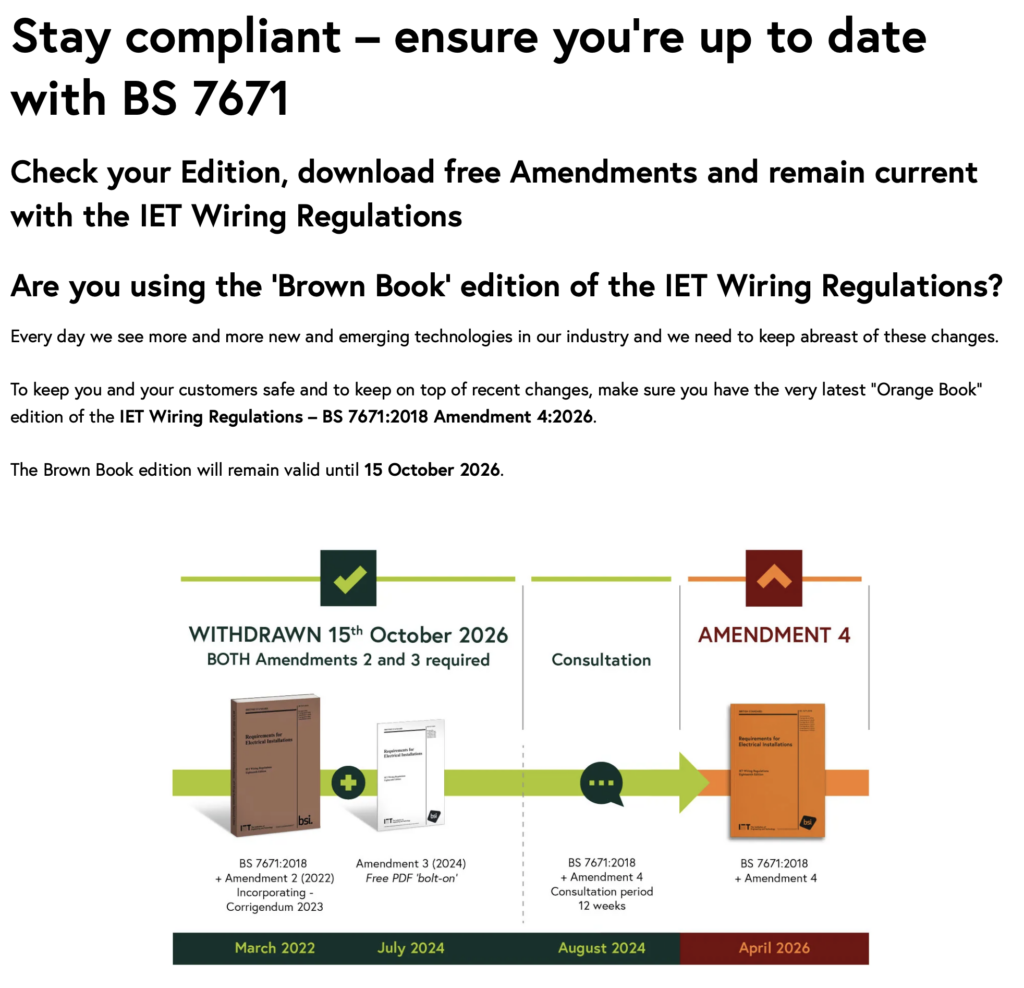
18th Edition Wiring Regulations (BS 7671 amendment 4) coming soon!
Book your place now ! Book your place now !! Book your place now !!!
BS 7671 Amendment 4 (2026): What Actually Changed
Amendment 4 to BS 7671:2018, published in January 2026 and effective from April 2026, introduces specific technical updates without fundamentally altering the regulation structure.
Major changes in Amendment 4:
Battery energy storage systems (new Chapter 82): A complete new chapter addressing stationary secondary batteries used for energy storage in residential and commercial installations. Covers lithium-ion battery safety requirements, installation locations, ventilation needs, disconnection devices, and protection against thermal runaway.
This responds to increased home battery storage adoption (often paired with solar PV) and several high-profile battery fire incidents in 2023-2025. Electricians installing battery systems must now follow specific requirements they weren’t legally obligated to meet under previous amendments.
Power over Ethernet (PoE) installations: Updated guidance for low-voltage network cabling systems that deliver power and data simultaneously (common in smart buildings, security cameras, VoIP phones). Addresses fire risk from higher-power PoE standards (up to 100W per port) and proper installation practices to prevent overheating.
Medical locations protections: Enhanced requirements for electrical installations in medical locations, particularly addressing risks in home healthcare settings where medical equipment (oxygen concentrators, patient monitoring, mobility aids) increasingly operates.
Functional Earthing and Functional Equipotential Bonding for ICT System : Refined earthing and bonding requirements for data centres and ICT installations, addressing electromagnetic compatibility and equipotential bonding needs.
What these changes mean for training:
Existing training courses (Level 2 and Level 3 Diplomas, NVQ programmes) will incorporate Amendment 4 content into their syllabuses. A learner starting Level 3 Diploma training in June 2026 will learn battery storage installation rules as part of their core curriculum.
Already-qualified electricians take short CPD update courses (typically 1-3 days) covering Amendment 4 changes. These are similar to the “18th Edition” courses many electricians completed in 2018-2019 when the 18th Edition was first published.
What these changes DON’T mean:
- There is no “Amendment 4 Qualification” that replaces or competes with NVQ Level 3
- Amendment 4 doesn’t create a new fast-track route to becoming qualified
- The pathway to ECS Gold Card status remains unchanged
- AM2 assessment standards remain the same (though test scenarios may eventually include battery storage installations)
- JIB grading criteria haven’t changed
Learners see “Amendment 4 Training” advertised and assume it’s a new qualification pathway. It’s not. It’s an update course for people who are already qualified, comparable to mandatory software updates for professionals in other industries.
Who is the qualification 9BS 7671) for?
This qualification is primarily aimed at practising electricians with relevant experience and other allied professionals eg surveyors, consultants and other trades needing to update and enhance their understanding of IET Wiring Regulations. It is also suitable for anyone wishing to demonstrate an understanding of the IET 18th Edition Wiring Regulations (BS 7671).
What does the qualification generally cover?
The IET Wiring Regulations (BS 7671) are the definitive standards for the electrical industry in respect of safe use and operation of electrical equipment and systems. They set requirements and operating criteria for the UK and correspond to EC standards and are recognised by the British Standards Institute as a British Standard (BS 7671). It is intended to ensure that individuals are conversant with the format, content and application of the Requirements for Electrical Installations BS 7671:2022
What You Will Study:
-
Structure of BS 7671
-
Protection for Safety
-
Selection & Erection
-
Special Locations
-
Inspection & Certification Requirements
Assessment: Online multiple-choice exam.
Outcome:
You will be able to interpret and apply wiring regulations confidently.
2365 Level 3 Diploma in Electrical Installations
Level 3 Diploma in Electrical Installations is an advanced qualification for candidates who have completed Level 2. The qualification intends to build complex skills in electrical design, testing, fault-finding, and environmental systems, paving the way to become a fully qualified electrician by leading to NVQ Level 3.
The program involves intensive theory and practical training covering scientific principles, BS 7671 wiring regulations, and modern technologies, preparing learners for employment or further specialisation in the electrotechnology sector:
Structure of Course
- Online Learning Formats : A “Hybrid” or “Blended” model:
- Self-Paced E-Learning: You study the theory modules at home (guarded learning) using our dedicated online platforms like LearnDash, MS Teams etc
- Virtual Classrooms: Live sessions with a tutor (evenings, 6 pm – 9 pm).
Level : Advanced Electrical Installation & Inspection
Purpose: To build advanced technical knowledge, design understanding, and inspection/testing competence.
Learners Will Study:
1. Advanced Electrical Science
-
Capacitance & inductance
-
Power factor
-
Three-phase systems
-
Fault current calculations
2. Inspection, Testing & Certification
-
Initial verification
-
Continuity testing
-
Insulation resistance testing
-
Earth fault loop impedance
-
RCD testing
-
Completing Electrical Installation Certificates
3. Fault Diagnosis & Rectification
-
Systematic fault-finding methods
-
Diagnosing circuit faults
-
Testing procedures
4. Electrical Installation Design
-
Maximum demand calculations
-
Cable sizing
-
Voltage drop calculations
-
Protective device selection
-
Discrimination & selectivity
Outcome at Level 3:
Learners achieve technical competence required to progress toward NVQ Level 3, AM2 assessment, and full electrician status
The City & Guilds 2365 Level 2 Diploma is the industry-recognized starting point for aspiring electricians. While the theory can be completed online via e-learning, the course requires mandatory in-person practical workshops and assessments.
What You Will Learn:
The qualification consists of five main units:
- Unit 201 : Health and Safety in Building Services Engineering.
- Unit 202 : Principles of Electrical Science (Maths and Science foundation).
- Unit 203 : Electrical Installations Technology (Theory of wiring systems).
- Unit 204 : Installation of Wiring Systems and Enclosures (The core practical unit).
- Unit 210 : Communication in Building Services Engineering.
Level : Foundation in Electrical Installation
Purpose: To develop core knowledge and fundamental practical skills required to begin working in the electrical industry.
Learners Will Study:
1. Health & Safety in Building Services
-
Safe isolation procedures
-
Risk assessments & method statements
-
PPE and safe working practices
-
Electrical hazards
2. Electrical Science
-
Basic electrical principles (Voltage, Current, Resistance)
-
Ohm’s Law & power calculations
-
AC & DC theory
-
Series and parallel circuits
3. Electrical Installations Technology
-
Wiring systems and containment
-
Cable types and selection basics
-
Earthing principles
-
Introduction to protective devices
4. Installation Methods
-
Practical wiring of lighting circuits
-
Ring and radial circuits
-
Consumer unit connections
-
Basic inspection and testing introduction
Outcome at Level 2:
Learners gain foundational knowledge and workshop competence, preparing them for more advanced design, inspection, and fault-finding at Level 3.